Author: Cindy Birck

  • EPAD at AD/PD2025

    EPAD at AD/PD2025

    The AD/PD™ Alzheimer’s disease and Parkinson’s disease Conference took place between 1-5 April in Vienna, Austria. The conference presented all the latest breakthroughs in treatment, translational R&D, early diagnosis, drug development and clinical trials in Alzheimer’s, Parkinson’s and other related neurological disorders.

    Among the many highlights, several oral presentations mentioned the EPAD project:

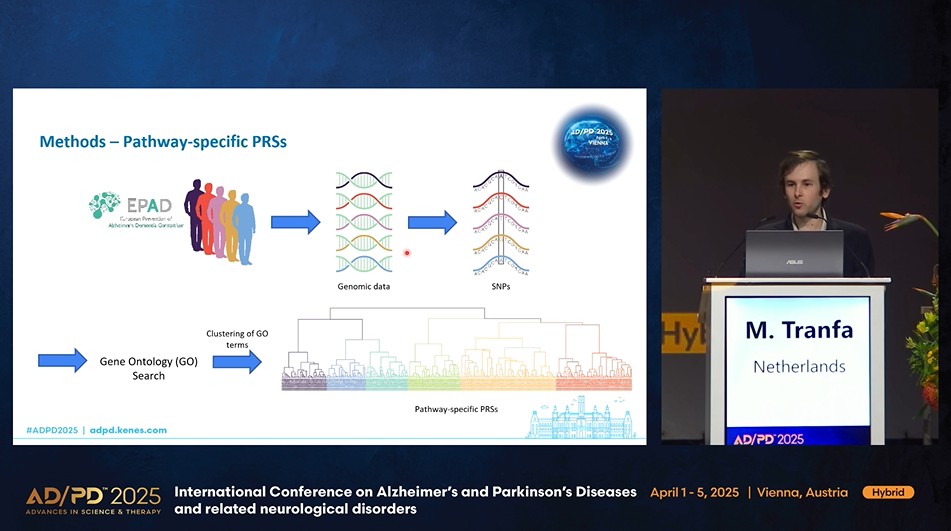
    1. “Polygenic Pathways Shape White Matter Vulnerability To Alzheimer’s Disease Pathology” – Mario Tranfa
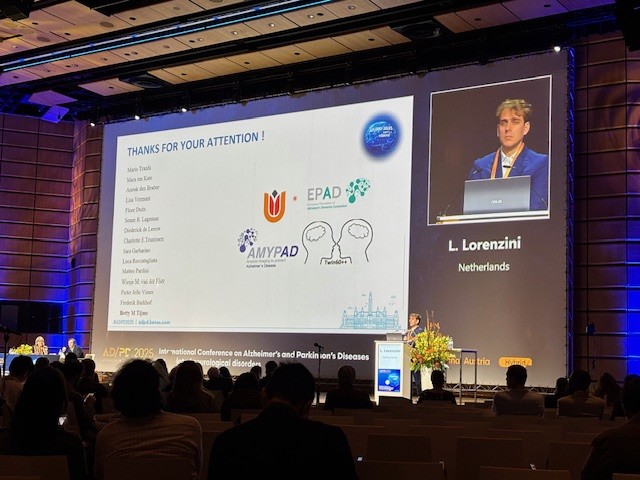
    2. “White Matter Integrity Measures Have Distinct Csf Proteomic Profiles In Non-Demented Subjects” – Luigi Lorenzini
    3. “Associations between polygenic risk scores and global amyloid deposition in the European AMYPAD consortium” – Emma S. Luckett
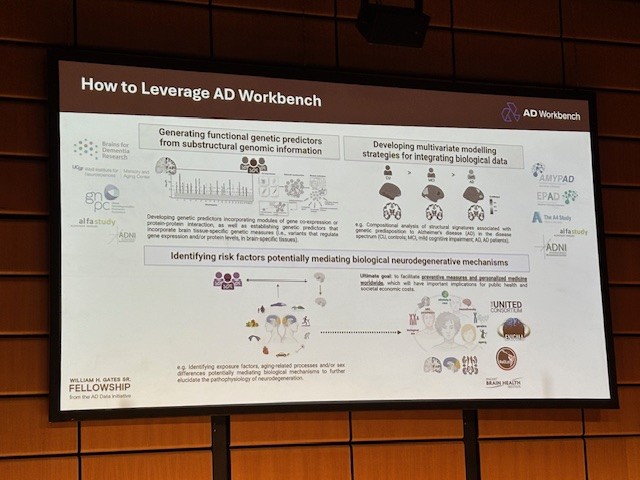
    4. “Leveraging AD Workbench for Alzheimer’s breakthroughs” – Natàlia Vilor-Tejedor
    5. “AI-Driven Classification Of Alzheimer’s Disease And Frontotemporal Dementia From Magnetic Resonance Imaging” – Robin Wolz

    EPAD offers a way of accessing the data, samples and image data collected during the EPAD Longitudinal Cohort Study to academic researchers, institutions and companies from all over the world. This is shared through secure online Workspaces via the Alzheimer’s Disease Workbench of the Alzheimer’s Disease Data Initiative who had a booth at #ADPD2025.

    For more information about the conference and the EPAD project, please visit AD/PD 2025 and EPAD’s website, respectively.
    Mario Tranfa
    Luigi Lorenzini
    Emma Luckett
    Natàlia Vilor-Tejedor

    by

    in

    The AD/PD™ Alzheimer’s disease and Parkinson’s disease Conference took place between 1-5 April in Vienna, Austria. The conference presented all the latest breakthroughs in treatment, translational R&D, early diagnosis, drug development and clinical trials in Alzheimer’s, Parkinson’s and other related neurological disorders. Among the many highlights, several oral presentations mentioned the EPAD project: EPAD offers…

  • Human Brain Mapping

    Human Brain Mapping

    “Grey-Matter Structure Markers of Alzheimer’s Disease, Alzheimer’s Conversion, Functioning and Cognition: A Meta-Analysis Across 11 Cohorts”

    Authors: Baptiste Couvy-Duchesne, Vincent Frouin, Vincent Bouteloup, Nikitas Koussis, Julia Sidorenko, Jiyang Jiang, Alle Meije Wink, Luigi Lorenzini, Frederik Barkhof, Julian N. Trollor, Jean-François Mangin, Perminder S. Sachdev, Henry Brodaty, Michelle K. Lupton, Michael Breakspear, Olivier Colliot, Peter M. Visscher, Naomi R. Wray, for the Alzheimer’s Disease Neuroimaging Initiative, the Australian Imaging Biomarkers and Lifestyle flagship study of ageing, the Alzheimer’s Disease Repository Without Borders Investigators, the MEMENTO cohort Study Group

    Abstract:

    Alzheimer’s disease (AD) brain markers are needed to select people with early-stage AD for clinical trials and as quantitative endpoint measures in trials. Using 10 clinical cohorts (N = 9140) and the community volunteer UK Biobank (N = 37,664) we performed region of interest (ROI) and vertex-wise analyses of grey-matter structure (thickness, surface area and volume). We identified 94 trait-ROI significant associations, and 307 distinct cluster of vertex-associations, which partly overlap the ROI associations. For AD versus controls, smaller hippocampus, amygdala and of the medial temporal lobe (fusiform and parahippocampal gyri) was confirmed and the vertex-wise results provided unprecedented localisation of some of the associated region. We replicated AD associated differences in several subcortical (putamen, accumbens) and cortical regions (inferior parietal, postcentral, middle temporal, transverse temporal, inferior temporal, paracentral, superior frontal). These grey-matter regions and their relative effect sizes can help refine our understanding of the brain regions that may drive or precede the widespread brain atrophy observed in AD. An AD grey-matter score evaluated in independent cohorts was significantly associated with cognition, MCI status, AD conversion (progression from cognitively normal or MCI to AD), genetic risk, and tau concentration in individuals with none or mild cognitive impairments (AUC in 0.54–0.70, p-value < 5e-4). In addition, some of the grey-matter regions associated with cognitive impairment, progression to AD (‘conversion’), and cognition/functional scores were also associated with AD, which sheds light on the grey-matter markers of disease stages, and their relationship with cognitive or functional impairment. Our multi-cohort approach provides robust and fine-grained maps the grey-matter structures associated with AD, symptoms, and progression, and calls for even larger initiatives to unveil the full complexity of grey-matter structure in AD.

    DOI: doi.org/10.1002/hbm.70089

    Published online: 3 February 2025 in the journal Human Brain Mapping

    by

    in

    “Grey-Matter Structure Markers of Alzheimer’s Disease, Alzheimer’s Conversion, Functioning and Cognition: A Meta-Analysis Across 11 Cohorts” Authors: Baptiste Couvy-Duchesne, Vincent Frouin, Vincent Bouteloup, Nikitas Koussis, Julia Sidorenko, Jiyang Jiang, Alle Meije Wink, Luigi Lorenzini, Frederik Barkhof, Julian N. Trollor, Jean-François Mangin, Perminder S. Sachdev, Henry Brodaty, Michelle K. Lupton, Michael Breakspear, Olivier Colliot, Peter M.…